Cluck AtlasField guide to fowl Get the field guide
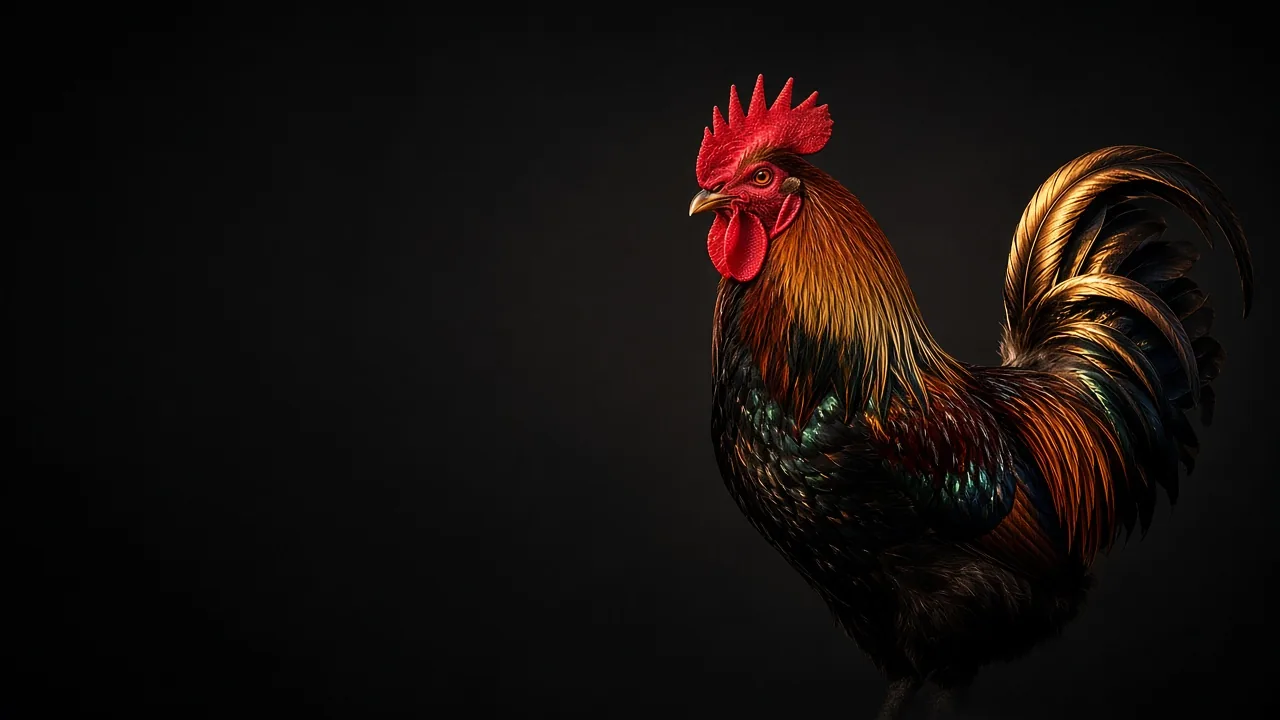
A heritage rooster lit by warm rim light against a near-black background, its scarlet comb and iridescent copper and emerald hackles glowing.

Plate 01 Gallus gallus domesticus

The chicken is the most underestimated animal on Earth.

It sees colours you have never seen, holds a grudge for months, warns its flock in words that mean specific things, and descends from the same branch of the tree of life as Tyrannosaurus rex. We spent four years collecting the evidence.

34 bn Living chickens on Earth — more than every other bird species combined
30+ Distinct vocalisations catalogued in the domestic hen
8,000 yrs Since red junglefowl first followed people out of the forest
4th Most-studied animal in cognition research published since 2010
Chapter one

Six things nobody told you about chickens

Every entry below comes from published animal-behaviour and veterinary literature rather than farmyard folklore. Where a claim is contested, we say so.

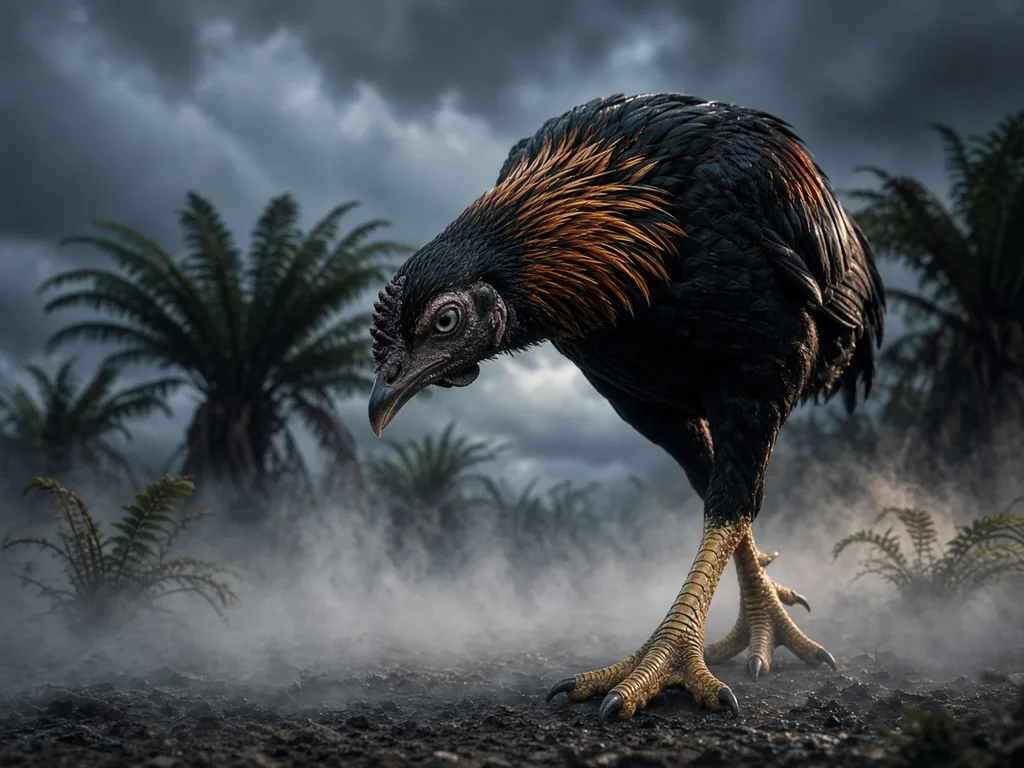
A lean black and copper game fowl rooster striding through mist, its scaled legs and claws giving it a prehistoric, reptilian look. Deep time

Your dinner is a dinosaur

Birds are not merely related to dinosaurs; they are the surviving branch of them. When researchers recovered collagen fragments from a 68-million-year-old Tyrannosaurus rex femur in 2007, the sequence they read matched chicken more closely than any other living animal they compared it against. Look at a rooster's scaled shin and three forward-facing toes and you are looking at a small theropod that never stopped running.

Asara et al., Science, 2007 — protein sequencing of T. rex collagen.
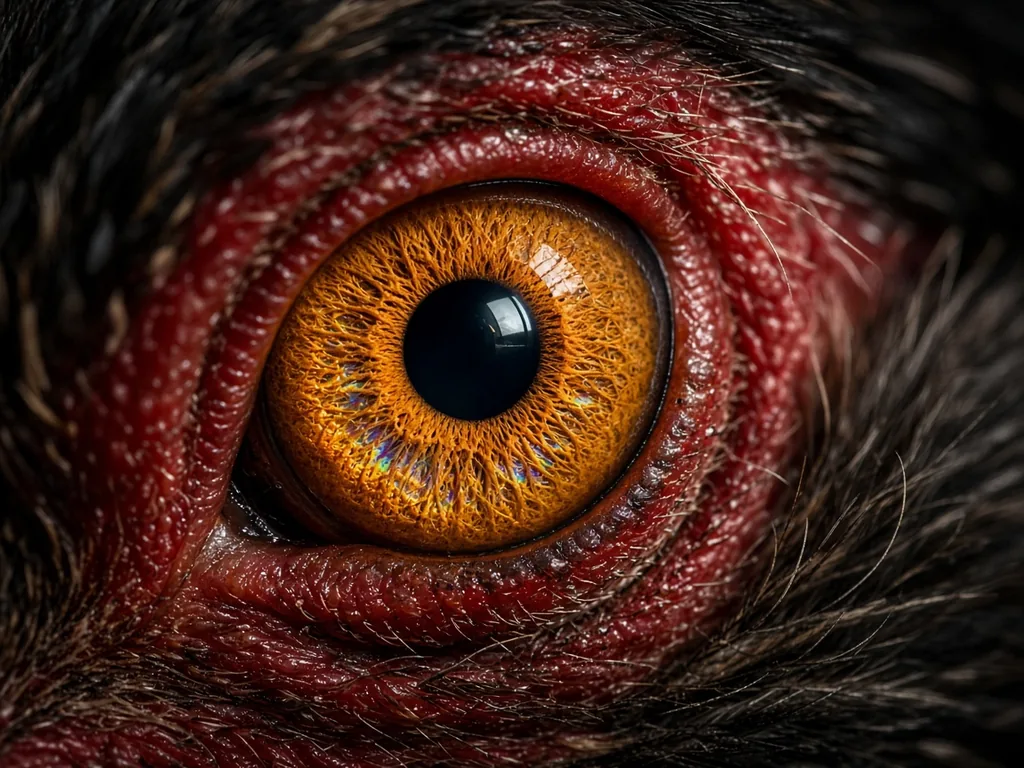
Extreme macro photograph of a hen's amber eye showing the fine radial fibres of the iris and faint prismatic colour on its surface. Perception

They see colours that do not exist for you

Humans are trichromats: red, green, blue. Chickens are tetrachromats with a fourth cone tuned to ultraviolet, plus a fifth "double cone" dedicated to detecting motion. Their cones are also arranged in a strikingly uniform mosaic that gives them sharper colour discrimination across the retina than we manage anywhere but the fovea. A hen inspecting bare-looking grass is reading a UV-marked map of ripe seed heads and insect trails.

Retinal cone mosaic described in Kram, Mantey & Corbo, PLoS ONE, 2010.

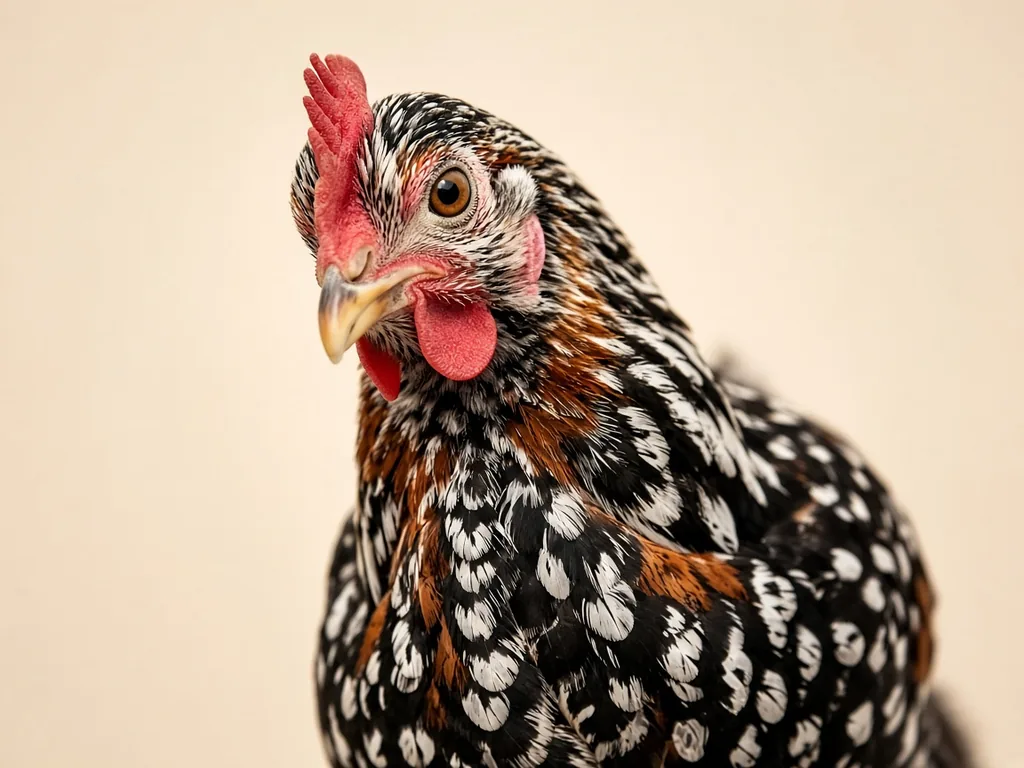
A speckled Sussex hen tilting her head and looking directly at the camera with an alert, curious expression. Cognition

She knows exactly who you are

A hen tells individual flock-mates apart by face and comb, and remembers who outranks her — the whole architecture of the pecking order depends on it. The term itself was coined in 1921 by the Norwegian zoologist Thorleif Schjelderup-Ebbe, who spent his adolescence writing down, bird by bird, who pecked whom.

Schjelderup-Ebbe, 1921 — the original Hackordnung study.

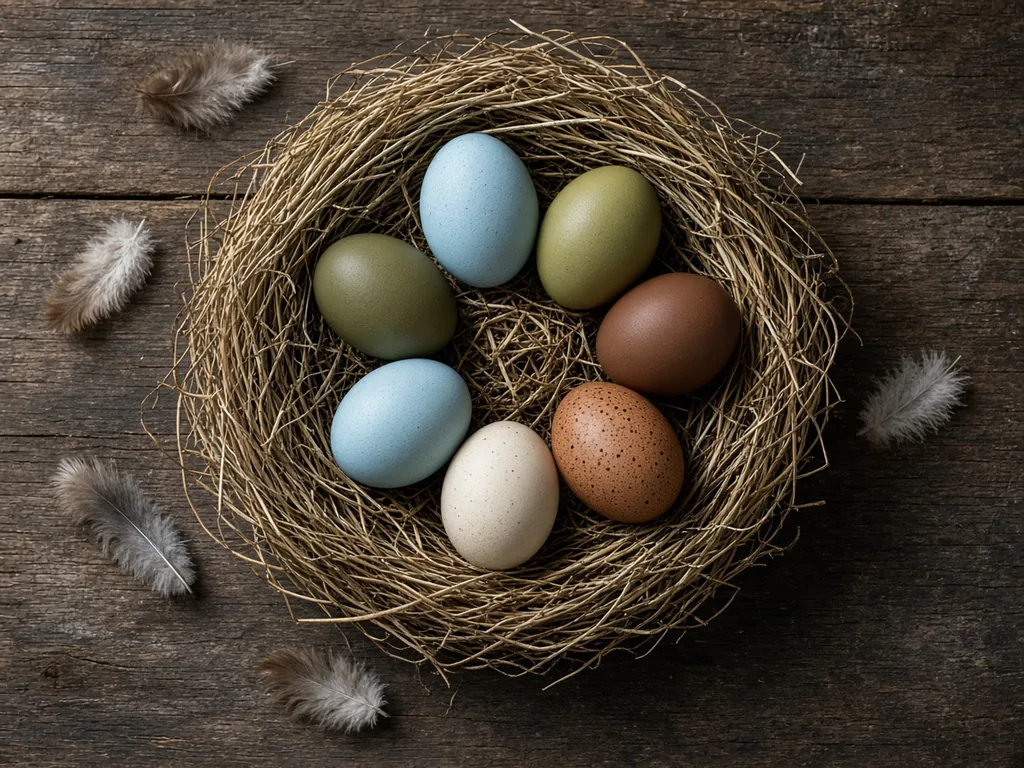
Overhead view of a straw nest holding six naturally coloured eggs in blue, olive, chocolate brown, speckled terracotta and cream. Genetics

Blue eggs are a 500-year-old virus

Every shell starts out white — calcium carbonate has no colour of its own. Brown is painted on in the final hours before laying and will rub off; blue goes all the way through, because the pigment is deposited as the shell forms. That blue exists at all is an accident: an ancient retrovirus inserted itself near a pigment gene in South American fowl and switched it permanently on.

Wang et al., PLoS ONE, 2013 — EAV-HP insertion in blue-egg breeds.

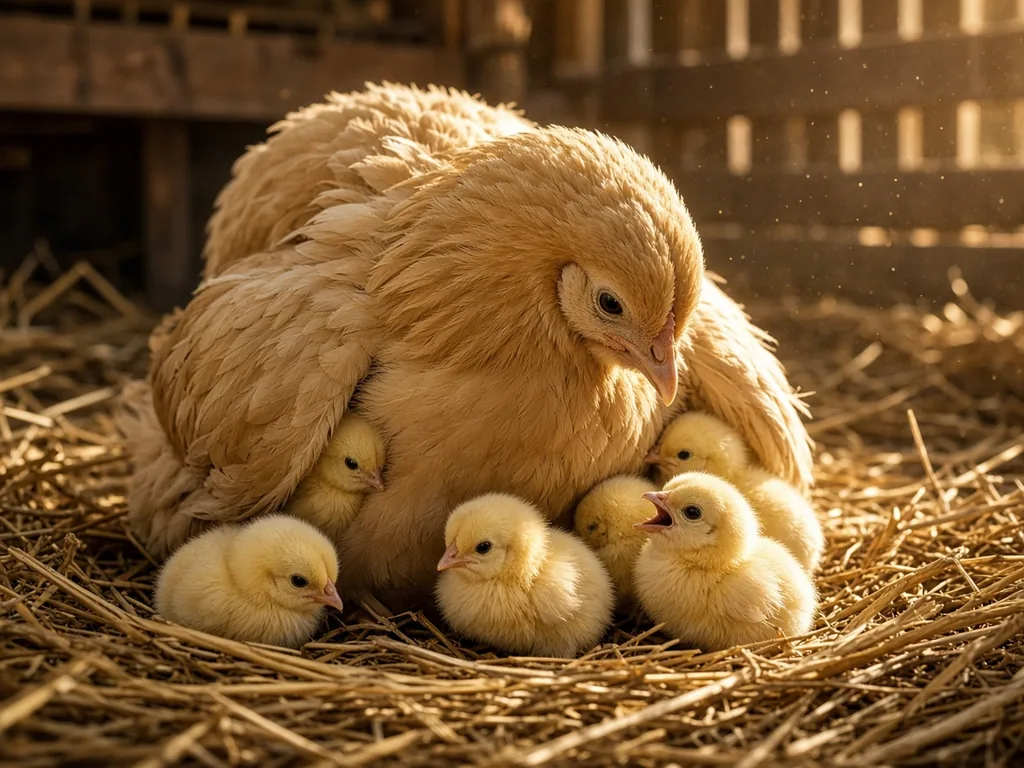
A buff-coloured mother hen sitting in golden straw with five yellow chicks, one peeping up at her with its beak open. Development

Chicks talk before they hatch

In the last day inside the shell a chick begins to click and peep, and its siblings answer. Clutches use this chatter to synchronise, so eggs laid over the course of a week hatch within a few hours of each other — which matters enormously, because a hen will leave the nest with whoever is ready and abandon the rest.

Vince, 1964 onward — classic work on hatching synchrony in Gallus.

07

Half a brain at a time

Hens on the exposed end of a roost sleep unihemispherically: one hemisphere shuts down while the eye on the outward side stays open and watching. Birds in the middle sleep with both eyes shut. They swap positions to share the burden.

08

The 26-hour clock

It takes a hen roughly 24 to 26 hours to build one egg, and she cannot start the next until the last is laid. That drift is why a productive hen lays a little later each morning, then skips a day and resets.

09

Roosters know the time

Crowing is driven by an internal circadian clock, not by light. Kept in constant dim light with no cues at all, roosters keep announcing dawn on an almost 24-hour cycle.

10

They can wait for more

Offered a small amount of food now or a larger amount after a delay, hens will hold out for the bigger reward — self-control that researchers describe as a prerequisite for anticipating the future.

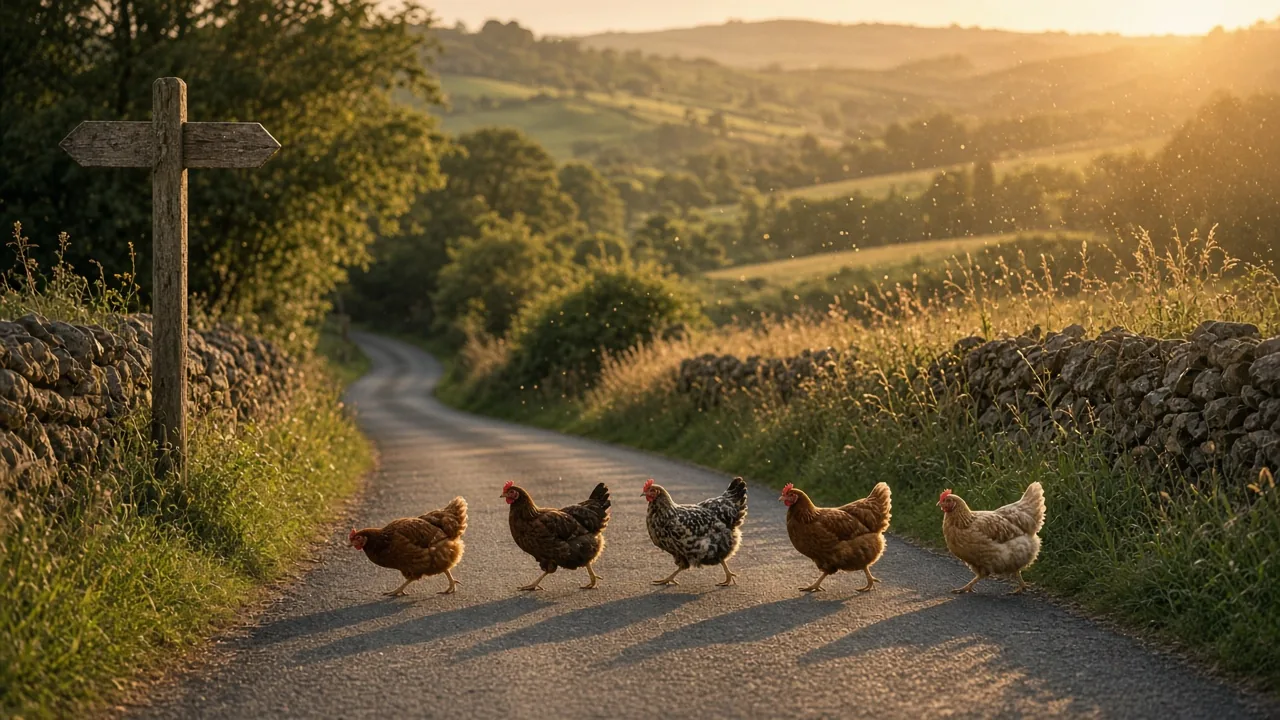
Five hens crossing a narrow country lane in single file at golden hour, framed by dry-stone walls and a wooden signpost.
Chapter two · Chicken Road

Chicken Road

The oldest joke in the English language has a straight answer, a real route, and a surprising amount of engineering behind it.

Chicken Road is not one lane in one village. It is the name we give to the strip of open ground every flock on Earth has to negotiate — the gap between where they sleep and where the good food is.

For most of the ten thousand years chickens have lived alongside us, that gap was trivial: a yard, a threshold, a track between two hedges. Then we paved it. A metalled road is, from a hen's point of view, an unusually flat clearing with warm dry edges, an abundance of small hard stones, and no cover whatsoever. Everything that makes it attractive is also what makes it lethal.

The five waypoints below are the honest version of the joke — what is actually going through a hen's head as she steps off the verge.

There are 'quips and quillets' which seem actual conundrums, but yet are none. Of such is this: Why does a chicken cross the street? Because it wants to get to the other side. The Knickerbocker, New York, March 1847 — the joke's first known appearance in print
  1. Waypoint one · 1847

    It was never meant to be funny

    The line was published as an anti-joke: a riddle with a deliberately flat answer, printed to poke fun at the fashion for elaborate conundrums. Its survival for nearly two centuries is a small miracle of comedy — the punchline works precisely because it refuses to be one.

  2. Waypoint two · The grit run

    She is going shopping for teeth

    Chickens have no teeth. Food is ground in the gizzard, a muscular organ that needs a supply of swallowed stone to work at all, and that grit wears down and must be replaced. Road verges — graded, drained, endlessly resupplied by passing tyres — are among the best grit deposits in an agricultural landscape. This is the single most common reason a hen steps onto tarmac.

  3. Waypoint three · The warm strip

    Tarmac is a spa

    Dust bathing is not optional behaviour; it is how a chicken manages skin parasites and conditions her feathers, and hens deprived of a suitable substrate will perform the whole ritual on bare concrete. A road holds heat long after the pasture has cooled and its shoulders stay dry in weather that turns a field to mud. In autumn, the warmest, driest, softest dust for two hundred metres is on the far side of the white line.

  4. Waypoint four · Social pull

    Because somebody senior went first

    Flocks move by contagion. When a high-ranking hen commits to a direction, the birds around her tend to follow within seconds, whether or not they have independently decided the trip is worth it. It is also why crossings happen in a line rather than a scatter — and why a whole flock can end up on the wrong side of a road that not one of them chose to cross.

  5. Waypoint five · The fix

    The first chunnel

    Smallholders solved this long before anyone wrote it down, and the solution has a name: the chunnel. A low corridor of wire mesh on a hoop frame, running from the coop to wherever the birds ought to be, it lets a flock cross ground it could not otherwise survive — under a drive, along a boundary, past the vegetable beds. Chicken Road stopped being a gamble the moment somebody put a roof on it.

1847 First printed appearance of the joke
6–8 s Typical time a hen spends on a single-track lane
30 g Grit an adult hen keeps in her gizzard at any time
12 m Longest single chunnel span that needs no mid-support
Version 2.0

Chicken Road 2

If the first Chicken Road was a problem to be survived, the second is a piece of infrastructure to be designed. Here is what happens when the lane leaves the ground.

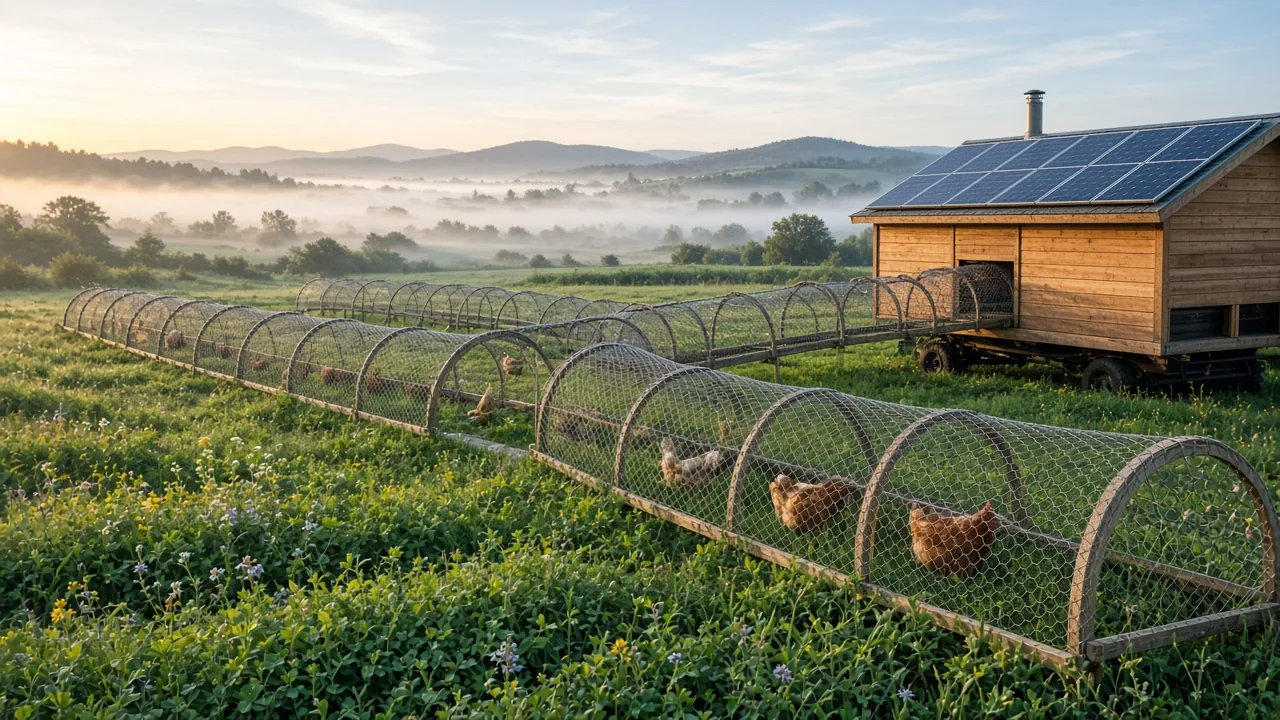
A network of arched wire-mesh chicken tunnels running across a misty green pasture toward a cedar mobile coop with solar panels on its roof.

Modular hoop tunnels

The chunnel grew up. Two-metre arch sections in galvanised mesh clip together without tools, so a route can be extended, curved around an obstacle or lifted and re-laid on fresh ground in an afternoon. The flock keeps its road; the road changes where it goes.

Doors that read the sky

A light-sensing pop-hole opens at civil twilight and closes once the last bird has roosted, running for a season on a palm-sized solar panel. It removes the two moments when flocks are most often lost — the morning nobody came out early enough, and the evening somebody forgot to shut the door.

The coop moves instead

Mobile housing towed to clean pasture every two or three days breaks the parasite cycle, spreads manure evenly rather than scorching one patch, and gives the birds fresh insects each move. The destination stops being a fixed point — the road follows the flock rather than the other way round.

Every bird on the map

Leg-mounted RFID tags logged at each pop-hole turned an assumption into data, and the data was humbling: a large share of a "free-range" flock barely leaves the shed apron, while a bold minority does nearly all the exploring. You cannot fix a road until you know who is actually using it.

Cover changes everything

Hens are prey animals that read open sky as danger. Plant trees, run shade sails, or simply leave tall strips of cover across a paddock and ranging distances rise sharply — the same birds, the same field, a completely different road because the ceiling changed.

Junctions, not dead ends

The newest layouts borrow from traffic design: T-junctions and loops instead of single spurs, so a subordinate bird cornered by a dominant one always has an exit. Aggression in a flock drops when the network stops producing places to be trapped.

Chicken Road vs Chicken Road 2
Aspect Chicken Road Chicken Road 2
Route Fixed, unplanned, whatever the ground allows Modular and re-layable in an afternoon
Overhead risk Open sky — hawks, kites, gulls Meshed or planted cover along the whole span
Who decides The highest-ranking hen, by impulse The layout — designed so every bird has an exit
Ground condition Bare and sour within one season Rested on rotation, manure spread evenly
What you know Roughly how many birds came home Which individual used which door, and when
Chapter three

Four birds that look designed by four different committees

There are well over five hundred recognised chicken breeds, all of them descended from the same forest bird. Here are four that show just how far selective breeding has travelled from the original blueprint.

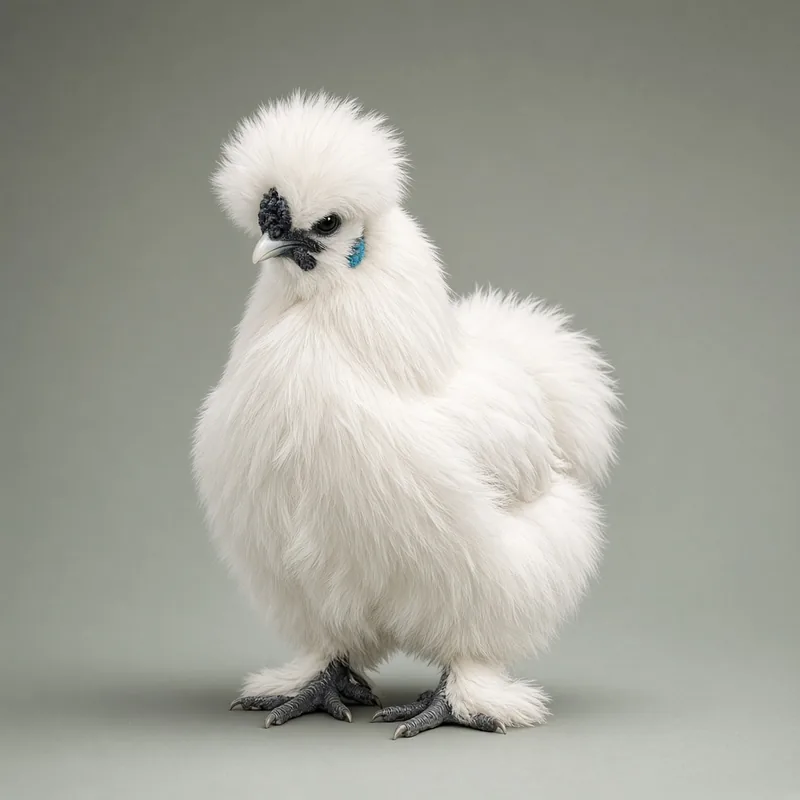
A pure white Silkie chicken with fur-like plumage, a rounded crest and dark blue face, photographed against a sage-grey backdrop.
China · pre-13th century

Silkie

Its feathers lack the tiny hooks that zip a normal feather into a smooth vane, so the whole bird looks like it is wearing fur. Marco Polo reported "hens which have hair like cats" on his travels; this is almost certainly what he saw.

  • Eggs / year≈ 100
  • ToesFive, not four
  • QuirkBlack skin and bones
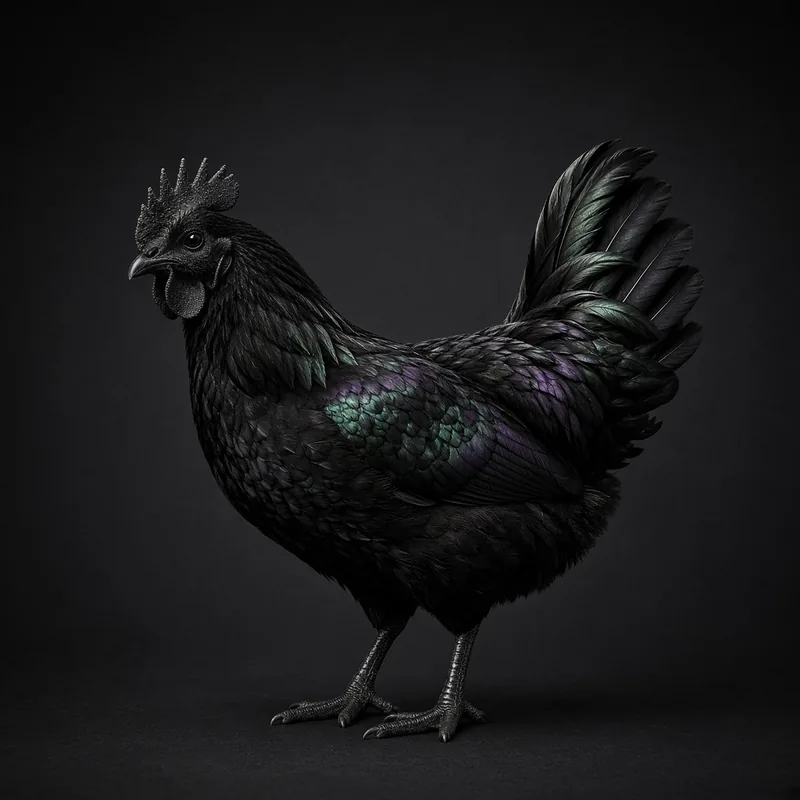
An Ayam Cemani chicken, entirely jet black including comb, skin and legs, with green and purple iridescence on its feathers.
Java, Indonesia

Ayam Cemani

Black feathers, black comb, black tongue, black bones. A genetic mutation called fibromelanosis floods the bird's connective tissue with pigment during development, colouring tissues that in any other chicken never see melanin at all.

  • Eggs / year≈ 80
  • Egg colourCream — not black
  • QuirkPigment reaches the organs
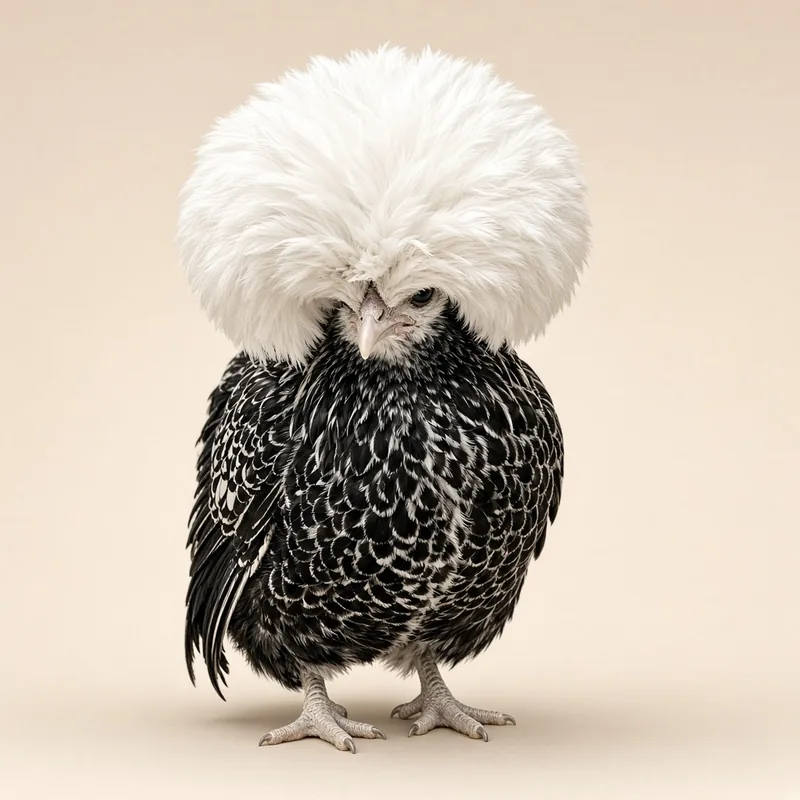
A Polish crested chicken with an enormous spherical white feather crest almost covering its eyes, above a black and white laced body.
Netherlands, via Poland

Polish

That crest sits on a small dome in the skull that houses part of the brain — the feathers grow from a genuine anatomical bulge. Because the crest blocks upward vision, Polish hens are notoriously easy to startle and need keepers to approach from the front and speak first.

  • Eggs / year≈ 200
  • Bred forOrnament since the 1500s
  • QuirkA domed, crest-bearing skull
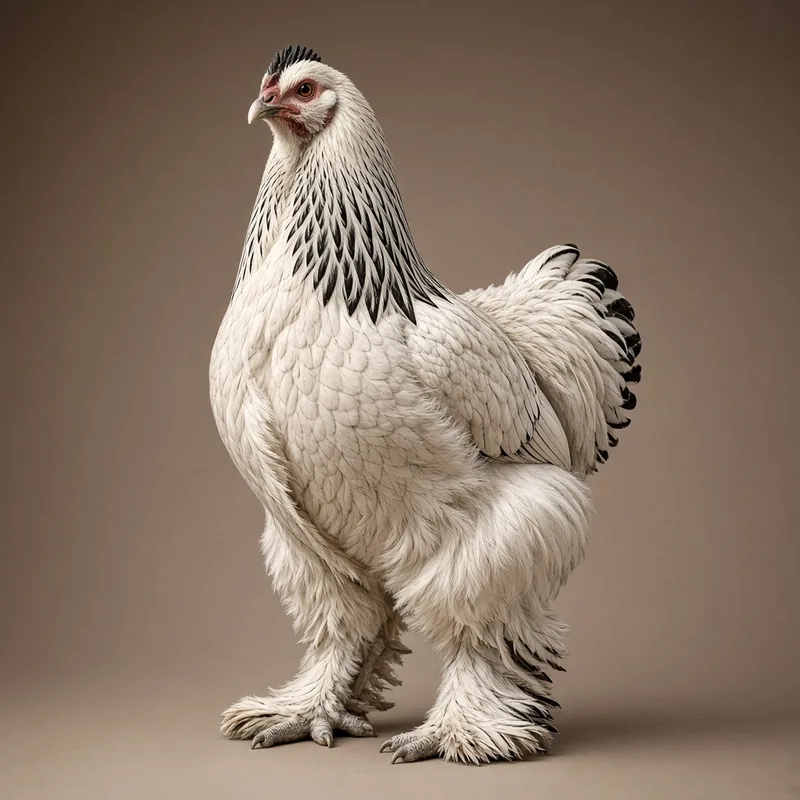
A large light Brahma chicken with creamy white plumage, black lacing on the neck and heavily feathered legs, standing on a taupe backdrop.
USA, from Shanghai stock

Brahma

A cockerel stands knee-high and can pass five kilograms. Their arrival in the 1840s set off "hen fever", a speculative craze in which single ornamental birds changed hands for more than a labourer earned in a year — and which collapsed just as fast.

  • Eggs / year≈ 150
  • HeightUp to 76 cm
  • QuirkLays best in midwinter
Chapter four

A short phrasebook of chicken

Several of these calls are referential: they do not merely express how the bird feels, they refer to a specific thing in the world, and flock-mates react correctly without seeing it. Tap any entry to translate it.

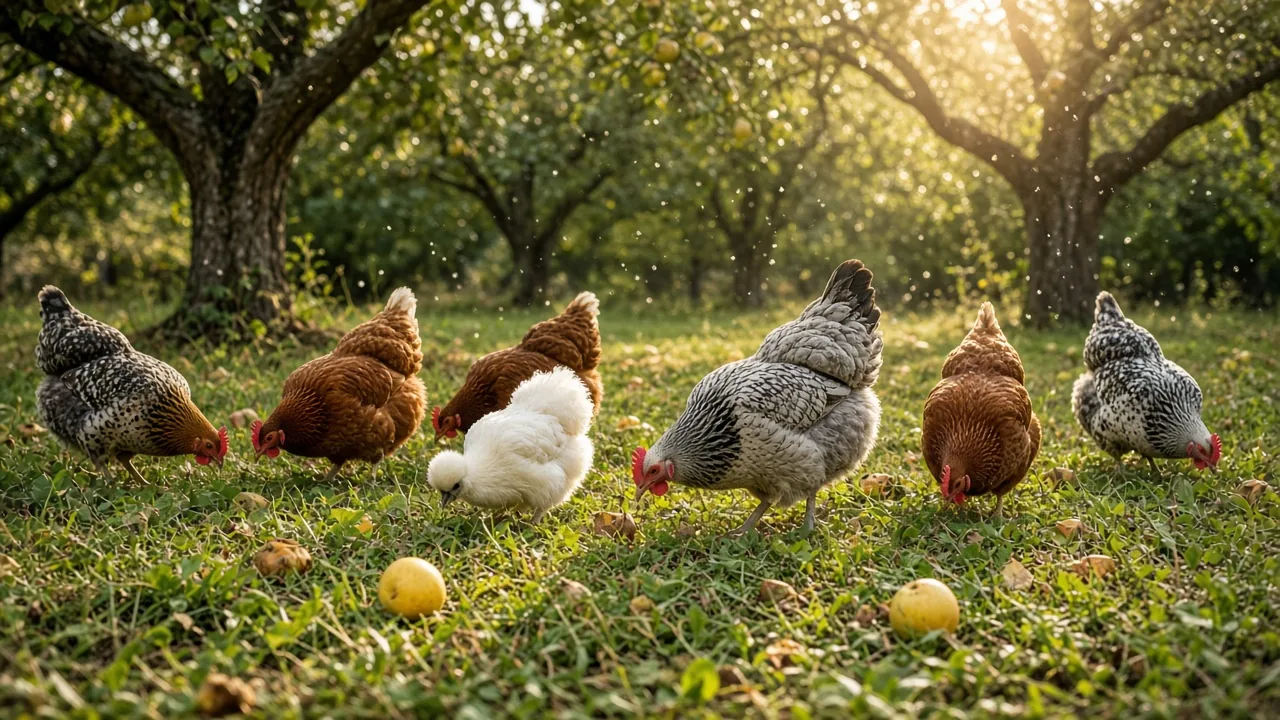
A mixed flock of heritage chickens foraging in dappled sunlight beneath old apple trees in an orchard.

Delivered loudly for up to a minute after laying, and often taken up by other hens in a chorus. One long-standing explanation is that a bird leaving the nest draws attention away from it; another is that it simply re-advertises her position to the flock she has been separated from. Either way, discretion is not the goal.

The aerial alarm is one long, high, pure note — a sound that is deliberately hard to locate. Hens hearing it crouch, freeze and scan upward, and they do so even when nothing is visible. This is the clearest evidence that chicken alarm calls carry specific information rather than general panic.

The ground-predator alarm is the opposite of the aerial one: low, broadband, sharply repeated and very easy to pinpoint — because the caller wants the flock to look at the fox, not hide from it. Birds respond by standing tall, craning and walking toward the sound.

A rooster who finds food picks it up, drops it, picks it up again and calls — a display known as tidbitting. Hens come running, and they remember which males call honestly. A rooster who tidbits over an empty patch quickly finds that nobody is interested any more.

Heard from a dust-bathing hen, from a bird settling onto a roost, and from a broody mother over her clutch. Contentment calls are among the most reliable welfare indicators available to a keeper: a silent flock is usually a worried one.

A sitting hen flattens herself, raises her hackles to look twice her size, growls and then hisses like a snake. The mimicry is thought to be genuine: nest predators that hesitate at the sound of a snake give the hen the second she needs.

Chapter five

Twenty-one days, from cell to chick

A hen holds her clutch at about 37.5 °C and turns each egg roughly fifty times a day. Miss the turning and the embryo sticks to the shell membrane. This is the schedule she is keeping.

Day1

The disc organises

The first structures of the nervous system appear within eighteen hours of warmth.

Day2

A heartbeat

The heart starts to beat before there is a body recognisable enough to hold it.

Day6

Beak and legs

Limb buds lengthen, the beak takes shape, and the first movements begin.

Day10

Feathers

Down follicles emerge and the claws harden. It now looks unmistakably like a chick.

Day14

Turning to position

The embryo rotates so its head lies under the right wing, ready for the air cell.

Day19

First breath

It punctures the internal air cell and breathes with its lungs for the first time.

Day20

Clicking

The chick calls through the shell and its siblings answer, synchronising the hatch.

Day21

Pipping

Using the egg tooth on its beak it cuts a ring around the shell — a job taking hours.

Chapter six

Questions we are asked most

Almost never out of curiosity. Hens cross for grit — the small stones they swallow to grind food in the gizzard, which collects along road verges. They also cross toward warm, dry, dust-bathing soil, toward richer foraging in the hedgerow opposite, and simply because a higher-ranking bird went first and the flock follows.

A chunnel is a long, low corridor of wire mesh over a light timber or hoop frame that links a coop to distant parts of a garden or pasture. It lets hens range and forage across a wide area while staying protected from foxes, hawks and traffic — and while keeping them out of the vegetable beds.

Far less than most people expect. Tracking studies of commercial free-range flocks consistently show that a large share of birds stay within roughly 20 metres of the shed, a smaller group ranges 50–100 metres, and only a bold minority explores the whole paddock. Overhead cover such as trees or shade sails reliably pushes those distances up.

Yes. Chickens discriminate between individual flock-mates and remember them, which is what makes a stable pecking order possible, and they also learn to tell individual human handlers apart. The ability underpins their social life rather than being a party trick.

They have a vocal repertoire of roughly two to three dozen distinct calls, several of which are referential — that is, the call refers to a specific thing in the world. A hen gives a different alarm for a hawk overhead than for a fox on the ground, and other birds respond appropriately even without seeing the threat.

Twenty-one days at roughly 37.5 °C. The heart begins beating on about day two, the embryo is recognisably a chick by day ten, and in the final twenty-four hours the chick clicks and peeps inside the shell — sounds that help a clutch synchronise so the whole brood hatches together.

The Coop Dispatch

One email a month: a new entry from the atlas, a breed profile, and whatever we have found in the week's animal-behaviour journals. No advertising, and you can leave with one click.

We store your address only to send this newsletter. See our Privacy Policy.